
Science and Technology Professionals Deliver "First Lesson of the Semester" to CUEBers
“I firmly believe that scientists are not here merely to ‘shake flasks’, but to ‘puzzle over problems!”
On September 14, Chi Haipeng, Founder and Chairman of Beijing Dynaflow Lab Solutions Co., Ltd., delivered a speech at CUEB, drawing unanimous applause from the audience. That day, the 2026 Publicity Series which brings front-line industrial science-and-technology professionals to universities was held at CUEB. Speakers from sectors including scientific instruments and next-generation information technology shared real-world stories of technical breakthroughs from industrial frontlines, offering students vivid and inspiring “firstlessonofthesemester”.
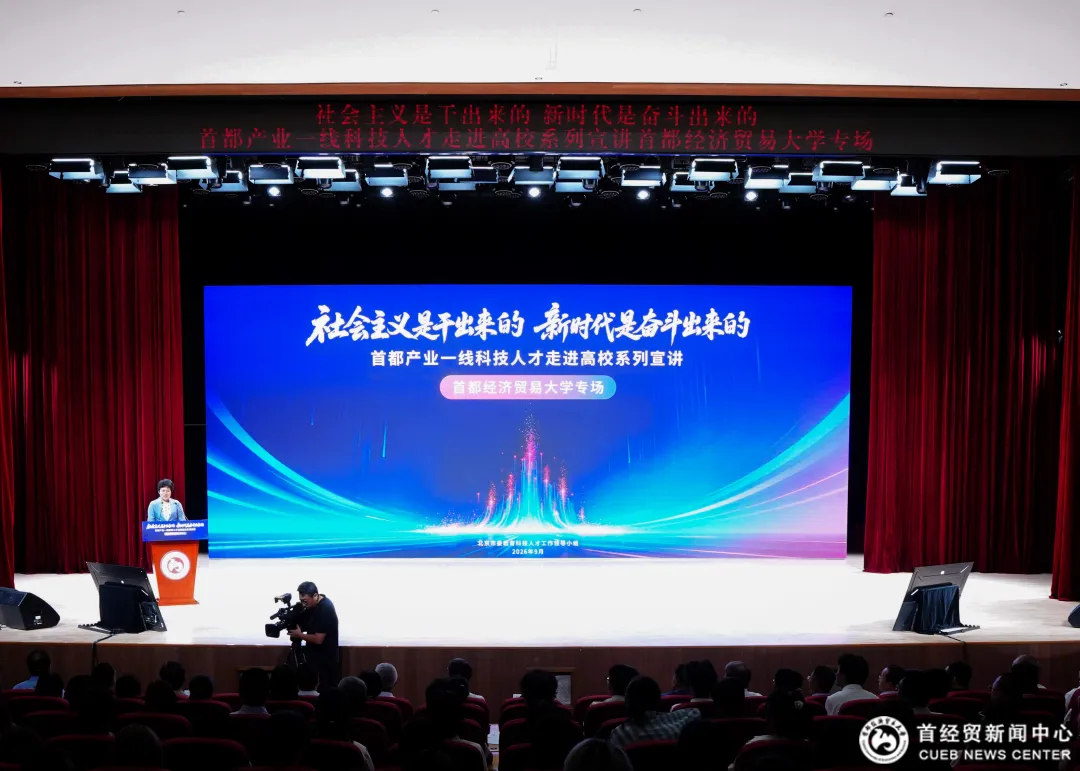
At the opening of the event, Liu Ying, CUEB Party Secretary, delivered an address. On behalf of the university, she thanked Beijing municipal authorities and relevant institutions for their long-term care and support for CUEB’s development, and extended a warm welcome to the experts. She noted that rooted in the university motto: “advocating morality, valuing competence, strategizing national development, and serving the people”, CUEB takes serving national strategies and Beijing’s development as its mission. Marking the university’s 70th anniversary this year, CUEB is advancing innovation platforms such as the InnoFusion Smart Valley (hereafter the Smart Valley)and the Interdisciplinary Digital Intelligence Experiment Platform exploring new models for future oriented discipline development and talent cultivation.
She pointed out that the distinguished experts hail from Beijing’s priority industries such as aerospace, chip manufacturing, and AI for Science. Confronting key technical bottlenecks holding back national development, they have worked out practical “Chinese solutions” through hands-on practice. They are key practitioners of the belief that “Socialism was established through action, and the new era will be no different”. Their stories will surely inspire CUEB students to foster patriotism, aspire to strengthen the nation, and commit to serving the country. She encouraged students to value this precious learning opportunity. Drawing on these experts’ experiences, students should embrace the mission of “bearing in mind national concerns and shouldering national responsibilities”, take up the torch of hard work, and become inheritors of the striving spirit.
Following the opening remarks, guest experts took the floor in turn.
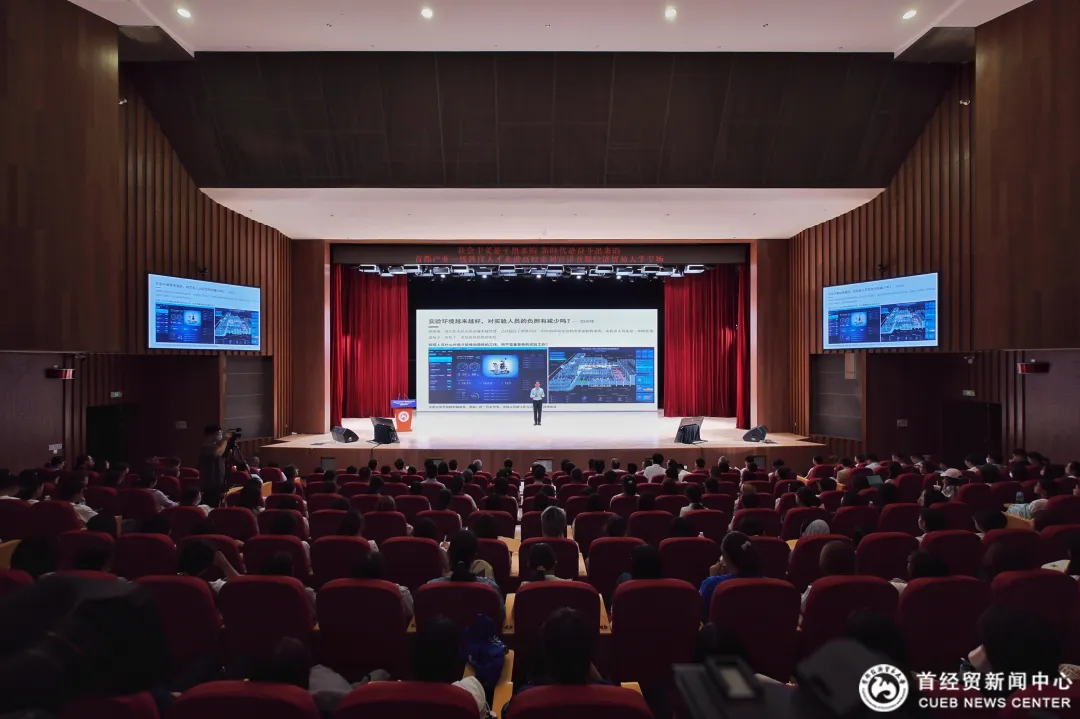
First to speak was Chi Haipeng, whose presentation was titled Paradigm Shift in Scientific Research: From “Shaking Flasks” to “Dark-Lab”. Twenty years ago, he was a college student at Beijing University of Chemical Technology, spending up to eight hours shaking flasks in the laboratory, his arms and legs aching from long hours of standing. Back then, a simple thought occurred to him: “Couldn’t we have a better setup to run experiments?”
Around 2020, Chi put forward the vision of building “Dark-Lab” facilities. His original aspiration was plain: “We aim to free scientists from repetitive manual labor.” Through repeated trials, his team developed “Dark-Lab” systems centered on AI-driven decision making, intelligent execution, and iterative data evolution, integrating AI-powered brains with diverse embodied capabilities across all operational links.
His entrepreneurial journey was far from smooth. He faced skepticism and witnessed team members depart. Even so, Chi remained steadfast: Chinese laboratories cannot stay stuck in the era of “flask-shaking”. In intelligent laboratory technology, China has great potential to move from keeping pace with global peers to taking the lead. “We are not just manufacturing equipment; we are redefining the future of laboratories.”
He left young students with a message: It will be you who define the future of Chinese science and technology!
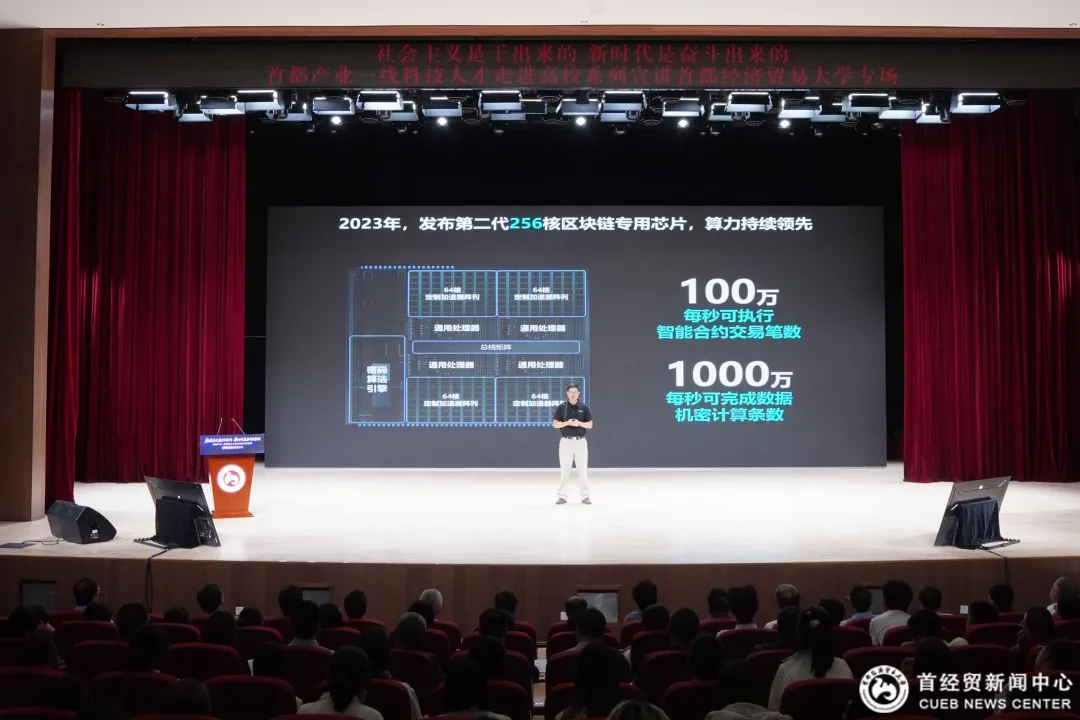
Zhang Bo, Director of the Hardware R&D Center the Beijing Academy of Blockchain and Edge Computing (BABEC), delivered a speech titled Chips and Chains on the Journey of Building National Blockchain Infrastructure. He recounted how his team developed home-grown dedicated blockchain chips while venturing into uncharted technological territory. His institute conducts organized research via a coordinated-campaign model, focusing on underlying blockchain operating-system architectures and dedicated blockchain chips.
Developing indigenous dedicated blockchain chips meant surmounting three major hurdles: stringent foreign technological blockades, adaptation to domestic production lines, and simultaneous assurance of performance and security. “We chose to start from the underlying architecture and build fully autonomous and controllable ‘Chinese chips’ from scratch,” Zhang explained.
Milestones include the world’s first 96-core blockchain-specific acceleration chip and BUDA (Blockchain Unified Device Architecture, “Bodhi”), China’s first open-source hardware architecture for blockchain-specific computing. Forging ahead amid technical blockades, the team achieved groundbreaking leaps from zero to one. Today, the Chang’an Chain software-and-hardware ecosystem, with over three million lines of core open-source code, stands as a benchmark for autonomous and controllable blockchain technology.
Currently, the National Blockchain Network Construction Project has been included in the national 15thFive-Year Plan. The team will continue to anchor itself to major national strategic needs, ensuring that the nation’s core blockchain underlying technology remains continuously leading, and truly consolidating a “trusted digital Great Wall” that connects the entire nation and links the world.
Zhang Bo also extended a sincere invitation to university students: “Let us together, on this hotbed of innovation in Beijing, forge chips and build chains, contributing our youthful strength to building a digital powerhouse and a cyber powerhouse!”
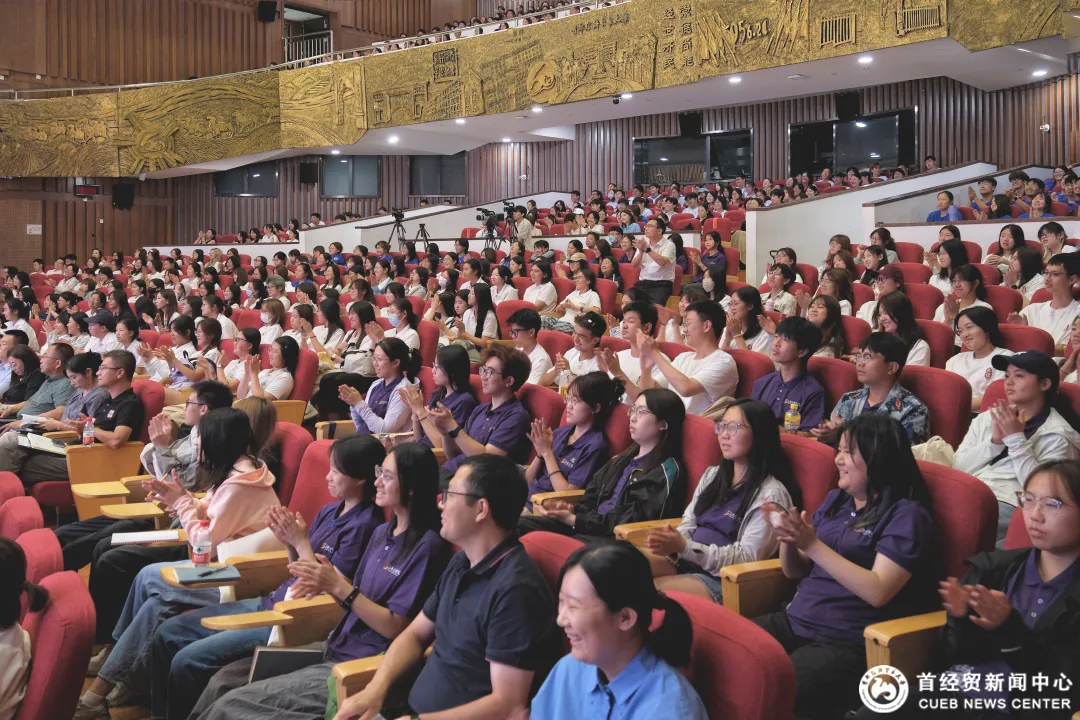
At the lecture site, the stories of frontline researchers taking root in industry and overcoming difficulties deeply moved the faculty and students present.
From the “lights-out lab” freeing scientists from repetitive labor to autonomous blockchain chips breaking through blockades, Gu Jing, an undergraduate student at CUEB’s School of Artificial Intelligence, saw a path of independent innovation paved with perseverance and lifted by practical effort. “Whether I continue my studies or enter the workforce in the future, I hope to build a solid professional foundation, apply technology where it can truly solve problems, settle down and do something substantive, and not let down the opportunities this era has given us.”
Professor Li Xue from CUEB’s School of Finance, who has long been engaged in teaching financial markets and investment and financing theory, found this lecture from the frontlines of scientific instruments and chip R&D to be a fresh source of inspiration. She reflected that the grand cause of technological self-reliance and self-strengthening cannot be separated from the powerful support of financial resources. “In my future classroom teaching, I will incorporate these vivid cases of independent innovation into my lectures, guiding students to break out of traditional financial thinking patterns and consider how finance can better empower the real economy and support the growth of hardcore technology.”
It is reported that this lecture series is organized by the Beijing Municipal Leading Group for Education, Science and Technology Talent, with the theme “Socialism is built through hard work; the new era is achieved through struggle.” From now until October, the lecture team will continue to visit universities including Peking University, Tsinghua University, and the University of Chinese Academy of Sciences, allowing university freshmen to experience up close the vivid practice of deep integration between technological innovation and industrial innovation.
HOT NEWS
- 1 Science and Technology Professionals Deliver "First Lesson of the Seme...
- 2 Science and Technology Professionals Deliver "First Lesson of the Seme...
- 3 School of Statistics and Data Science Holds Opening Ceremony for 2026 ...
- President Wu Weixing Meets with Bill Flanagan, President of University...
- Top-Tier Publication | Faculty Member Wei Xinbei from the School of Fi...