
CUEB Hosts 14th International Conference on Futures and Derivatives
On November 15-16, the 14th International Conference on Futures and Other Derivatives (ICFOD) was convened at CUEB. The opening ceremony featured addresses by Li Kunpeng, Member of the Standing Committee of School Party Committee and Vice President, and was chaired by Zhou Kaiguo, Dean of the School of Finance.
Centered on the deep integration of AI and derivatives markets, the conference brought together over 60 domestic and international experts and scholars. Through keynote addresses, roundtable discussions, and parallel sessions, participants discussed front-edge topics such as derivatives pricing, risk management, and climate finance.

The morning keynote session, chaired by Professor Zhang Qunzi (Shandong University), featured three presentations. Professor Bart Frijns (Auckland University of Technology) examined FOMC announcements as major news events, exploring how the information environment shapes market quality. His research demonstrated that greater analyst-forecast dispersion—a sign of information opacity—is linked to wider bid-ask spreads and higher trading volume, yet lower price efficiency. He also found that heightened information asymmetry before announcements spurs investors to seek private information, underscoring the critical role of the information environment around major news. Professor Liu Yuzhen (Peking University) pioneered deep AI-finance integration. She described integrating satellite remote-sensing data with deep-learning to improve futures pricing, introduced the concept of “financial DNA” using big data and experiments to pinpoint investor preferences and biases, and employed generative AI to customize financial services and create personalized investor education. Finally, she quantified non-traditional market sentiment—including the correlation between music mood and stock returns—using large language models. Professor Robert I. Webb (University of Virginia) highlighted the weather’s highly localized and time-sensitive impact on the prices of agricultural and some non-agricultural commodities in his speech “Weather and Trading”. He discussed weather derivatives as hedging tools (noting liquidity and scale constraints), and pointed to the practical advantages of localized weather data and collaboration with meteorological experts.
In the afternoon keynote session chaired by Zhao Daping, Vice Dean of the School of Finance, Professor He Feng (CUEB) delivered a keynote speech titled “Futures Trading and High-Quality Corporate Development”. He highlighted that futures trading can significantly enhance the total factor productivity of energy-dependent firms, reduce firm-specific risks and exposure to climate-policy uncertainty, curb excessive financialization, and ultimately support corporate innovation as well as improved stock market performance. Liu Yingyi (Publisher for Economics, Elsevier) shared practical guidance on academic publishing—from writing and peer review to career planning—tailored to researchers’ needs.
After the keynotes, Professor Yin Libo (Central University of Finance and Economics) chaired a roundtable discussion on “AI and Derivatives Markets”. Professor Han Liyan, Professor Wang Changyun, Professor Li Ping, and Dr. Zhang Huiyan discussed AI applications for pricing efficiency, risk identification and control, and market liquidity, as well as associated ethics and regulatory challenges, offering constructive proposals to support high-quality development of the field.
The conference finally announced the Best Paper Awards, honoring three scholars for original contributions to derivatives research.
On the afternoon of November 15, the invited talks were held in Tianlang Hall, chaired by Associate Dean Sha Yezhou of the School of Statistics and Data Science (CUEB). Professor Bu Hui (Beihang University) reported on weighted causal network analysis that separates positive and negative causal links in international commodity-futures markets, sharing new findings and insights. Professor Liu Yanchu (Sun Yat-sen University) presented LLM-based option pricing, showing that pricing factors generated by LLMs perform well in options markets and offer fresh avenues for pricing research.
The conference featured seven parallel sessions on cutting-edge topics including LLMs in derivatives pricing and risk management, text analytics in derivatives markets, and AI and climate derivatives. Scholars delved into LLMs’ value in derivatives pricing, showcasing novel pricing frameworks for commodity options and credit default swaps (CDS) that leverage LLMs’ capabilities in text comprehension and data analysis to pursue sharper accuracy and faster pricing updates.
On November 16, the “Meet-the-Editors” session gave young scholars direct access to leading editors. The editors shared insider perspectives on what makes a paper stand out, stressing novelty and relevance. They motivated attendees to focus on pioneering work and provided actionable advice to navigate the publishing landscape, offering clear guidance for their academic development.
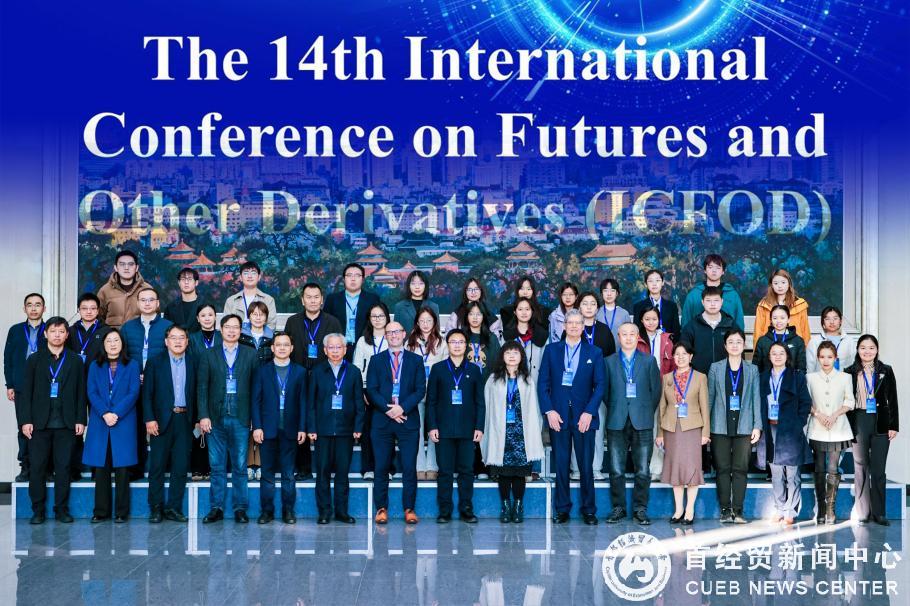
The successful ICFOD advanced scholarly exchange in financial derivatives, spotlighted the deep integration of AI and derivatives markets, and produced results with both academic and practical value—further boosting the international influence of CUEB’s finance discipline.
HOT NEWS
- 1 CUEB Hosts 14th International Conference on Futures and Derivatives
- 2 CUEB Hosts 14th International Conference on Futures and Derivatives
- 3 CUEB Hosts Online Job Fair for Returned Overseas Scholars
- School of Foreign Studies Hosts Symposium on Embodied-Cognitive Transl...
- 2025 ESG Summit & Green Transition Forum Held in Beijing: Empowering E...