
CUEB’s Five Scholars Rank Among Stanford’s 2026 World’s Top 2% Scientists
Recently, Stanford Universityreleased the 2026 World’s Top 2% Scientists List. Three scholars fromCUEB have been named to the “Career-long Impact” list, and five to the “Single-year Impact”list.
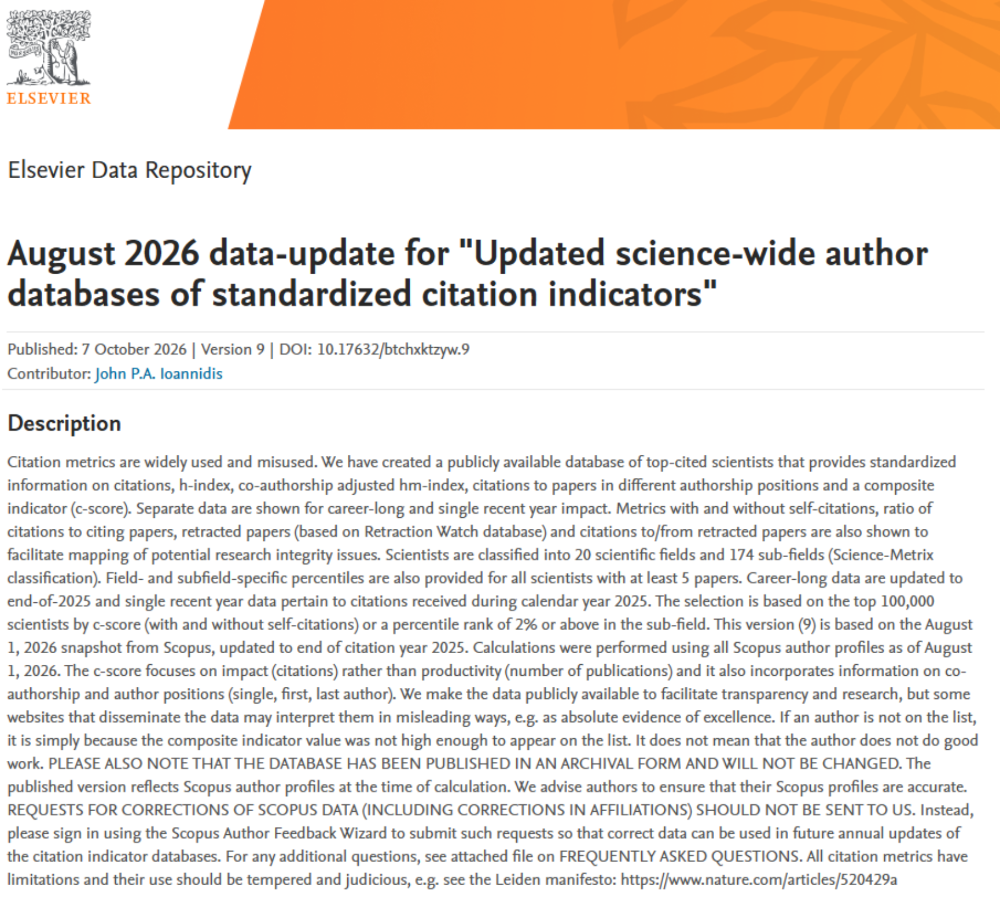
Scholars on the “Career-long Impact” list are Zhang Dongyang, Chen Wei and Wang Dadi.
Those on the “Single-year Impact” list are Zhang Dongyang, Chen Wei, Wang Dadi, He Feng, and Hao Jing.
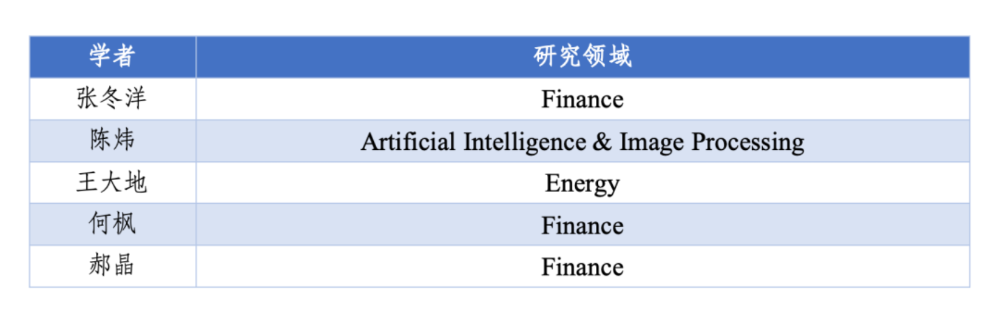
Selected Scholars
Released on Elsevier’s Mendeley Data, the list of global top 2% scientists is the cooperation between Elsevier and Professor John P. A. Ioannidis’ team. It serves as a comprehensive criterion to measure scientists’long-term research performance, showing scientists’influence more objectively. The list is based on the Scopus database. Using six metrics including citation count, h-index and hm-index, it identifies the world’s top 2% of scientists from a global pool of 7 million researchers according to their “Career-long Impact” and “Single-year Impact”. Scientists are categorized into 22 fields and 174 subfields. The list comprehensively evaluates scientists’ research status and long‑term research performance. Inclusion on the list signifies that the scholar enjoys high global influence within their field of research. This is the 2026 edition, released on October 7, 2026. The dataset for the “Career‑long Impact” list is updated to the end of 2025, while the “Single‑year Impact” list captures citations accumulated in 2025.
Profile of Selected Scholars
Zhang Dongyang is a professor and doctoral supervisor at the School of Economics, Deputy Director of the Personnel Office, a Beijing High-level Returnee (municipal talent title for scholars returning from overseas study), and Beijing Young Scholar. In 2025, he was named to the “Career-long Impact” listof World’s Top 2% Scientists by Stanford University. In fact, he has been consecutively listed as the World’s Top 2% Scientists from 2022 to 2026, and on Elsevier’s Most Cited Chinese Researchers list from 2022 to 2025. He has also been honored as “Leader of Distinguished Young Scholars”by CUEB. He led over ten national and provincial-level research projects and published more than 80 academic papers as sole author or first author in leading domestic and international journals, including Research Policy, Journal of Economic Behavior & Organization, Journal of International Money and Finance, China Economic Review, as well as Chinese journals such as Economic Management, Nankai Business Review, Public Finance Research, and Economic Theory and Business Management. His research covers applied micro econometrics, corporate finance, corporate governance and environmental economics.
Chen Wei is the Dean, a Doctoral Supervisor and professor of the School of Management and Engineering. He also serves as the Director of CUEB Quantitative Finance Research Centre, Standing Director of Society of Management Science and Engineering of China (SMSE), Director of Chinese Society for Optimization, Overall Planning and Economic Mathematics, Vice Chair of the Intelligent Computing Branch of the Operations Research Society of China, and the editorial board member of Chinese Journal of Management Science andOperations Research and Management Science. He led a number of research projects, including one keyproject and twogeneral projects funded by the National Natural Science Foundation of China (NSFC), two projects by the Humanities and Social Science Foundation of the Ministry of Education, one key project by the Beijing Social Science Foundation, and published a number of papers in journals such as IEEE Transactions on Fuzzy Systems (IEEE TFS), Annals of Operations Research (AOR), Information Sciences (INS), Pattern Recognition (PR), International Journal of Forecasting (IJF), Journal of Management Sciences in China, and Systems Engineering: Theory & Practice. His research areas coverquantitative finance and risk management, blockchain finance, artificial intelligence and large language models.
Wang Dadi is a professor and doctoral supervisor of the Department of Corporate Sustainability in the College of Business Administration, as well asAssociate Editor of Socio-Economic Planning Sciences. He also chaired many research projects in NSFC and other projects. His research coverssustainable development, environmental, socialand governance (ESG), energy environment, supply chain management, and business management.
He Feng is a professor and doctoral supervisor at the School of Finance, the Deputy Director of the Office of Research at CUEB, and also serves as the Director of the Climate Finance Research Center at the China ESG Institute. He was selected for the inaugural Youth Program of the National Cultural Talent Project, and the World’s Top 2% Scientists list by Stanford University and the Most Cited Chinese Scholars on Elsevier in 2025. He is also a recipient of “Leader of Distinguished Young Scholars” award at CUEB and serves as Editor-in-Chief of the International Review of Economics& Finance. He led three national research projects and published over 100 academic papers in key domestic and international journals, including Management World, Journal of Management Science in China, Nankai Business Review, Journal of Business Ethics, Journal of Economic Behavior & Organization, Journal of Banking & Finance, Annals of Tourism Research and Journal of Futures Markets. More than ten of these papers are ESI highly cited papers and hot papers. His research interests cover green finance, law and finance, corporate finance, digital economy, and risk management.
Hao Jing is an associate professor and doctoral supervisor of the School of Accounting, and a winner of “Leader of Distinguished Young Scholar” award by CUEB. She has led six projects, including the Youth Project funded by the NSFC, major projects funded by the Beijing Social Science Foundation, and projects funded by Humanities and Social Science Foundation of the Ministry of Education. Seven governmental reports have been recognized by provincial and ministerial officials. She has published a monograph titled Investor Attention and Corporate Governance and co-translated the Financial Ecosystems and Strategies in the Digital Age: Global Perspectives and New Opportunities. She has also published more than 50 papers in major domestic and international journals such as Journal of Management Sciences in China, Systems Engineering Theory and Practice, Journal of Business Ethics, Journal of Economic Behavior & Organization. Many of these papers have been selected as ESI hot papers and highlycited ones. She also serves as the 14th Director of the Social and Economic Systems Engineering Committee of the Systems Engineering Society of China, Associate Editor of Journal of Asian Economics, Managerial & Decision Economics, Global Finance Journal, and Guest Editor of Energy Economics and Pacific-Basin Finance Journal. Her research areas are corporate governance, risk management, corporate finance, green finance, and behavioral finance.
HOT NEWS
- 1 CUEB’s Five Scholars Rank Among Stanford’s 2026 World’s Top 2% Scienti...
- 2 CUEB’s Five Scholars Rank Among Stanford’s 2026 World’s Top 2% Scienti...
- 3 CUEB Signs Strategic Cooperation Agreement with Beijing Daily Group
- CUEB Stages Aesthetic Education Achievements Showcase for Its 70th Ann...
- CUEB Hosts Key Academic Event for Its 70th Anniversary: “Serving the W...