
CUEB President Wu Weixing Meets with GIMPA President Samuel K. Bonsu
On the morning of December 9, Wu Weixing, Deputy Party Secretary and President of the Capital University of Economics and Business (CUEB), met with Samuel K. Bonsu, President of the Ghana Institute of Management and Public Administration (GIMPA), at Hechang Hall in Boyuan Building. Vice President Li Kunpeng, Member of the Standing Committee of CUEB Party Committee, attended the meeting. The two sides held in-depth discussions on advancing inter-university cooperation, promoting joint programs, and fostering scientific research and innovation.
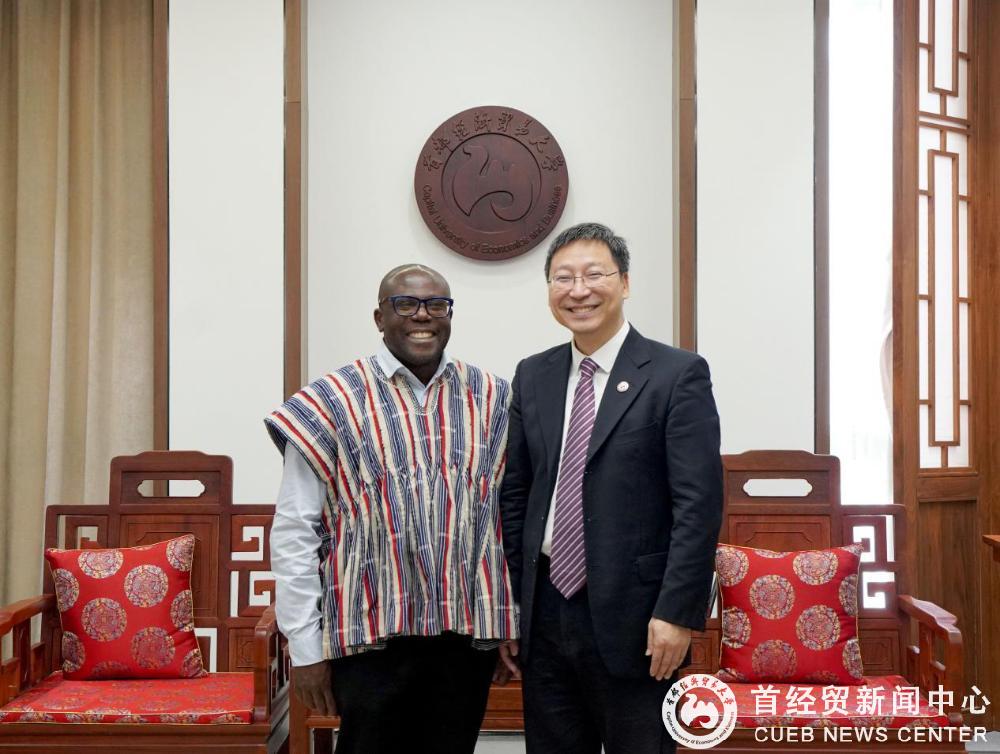
On behalf of the university, Wu extended a warm welcome to President Bonsu and briefly introduced CUEB’s history and discipline features. He noted that CUEB has always upheld the concept of open education policy and looks forward to working with GIMPA through in-depth cooperation in economic management, public policy, and urban governance. He added that CUEB will continue to expand multi-level cooperation mechanisms—including student exchanges, faculty mutual visits, and joint research—to jointly build a long-term and stable partnership.
President Bonsu thanked CUEB for the warm reception and introduced GIMPA’s history, discipline strengths, and international cooperation. He said that GIMPA attaches great importance to cooperation with CUEB and is willing to pursue comprehensive and pragmatic cooperation in academic exchanges, personnel cultivation, and scientific research and innovation.
Li Kunpeng put forward a series of proposals on specific cooperation. In terms of personnel cultivation, CUEB welcomes Ghanaian students to pursue studies in China, explores a master’s-level “1+1” joint program, designs themed summer study camps, and promotes the share resources network of digital teaching resources. In terms of professional capacity building, the two sides can jointly develop short-term training courses for Ghanaian civil servants, online micro-credential programs, and job-shadowing placements. In terms of scientific research cooperation, he suggested jointly building a research platform, taking turns hosting branded academic forums, and collaborating to publish high-level English academic research outcomes.
President Bonsu expressed strong agreement with the proposals and noted that the two sides can start by launching student exchange programs and then gradually expand to scientific research cooperation and faculty mutual visits, thereby jointly establishing a sustainable cooperation and development mechanism.
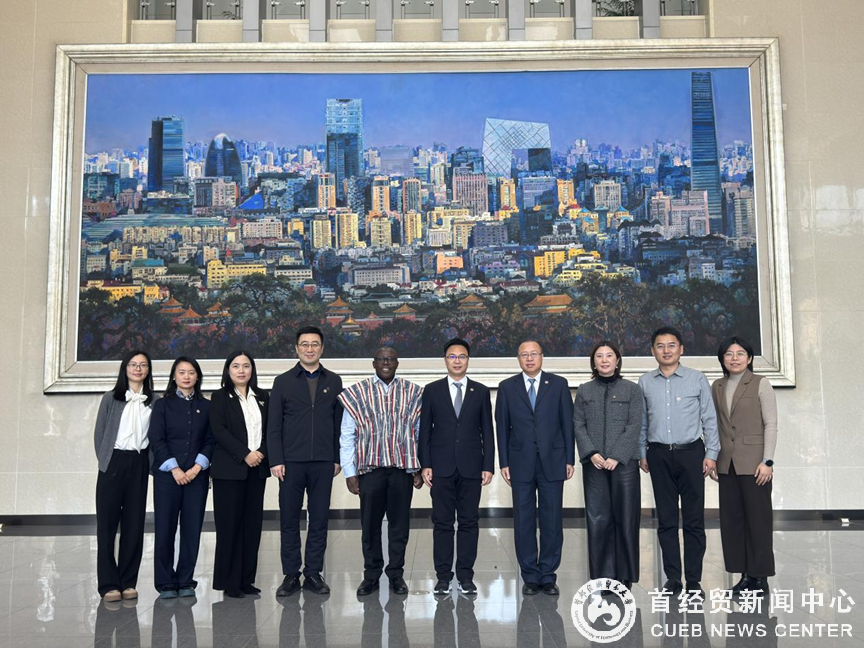
Liu Wenchuan, Director of the Office of International Cooperation and Exchange and Dean of the School of International Education; Ma Baobin, Dean of the School of Urban Economics and Public Administration; Wei Huaying, Deputy Director of the Office of International Cooperation and Exchange; Wu Xiaoxia and Zhang Pengyan, Deputy Deans of the School of Urban Economics and Public Administration; Pan Na, Dean Assistant; Shi Chenchen, foreign affairs assistant; and Wu Ke, project supervisor of the Office of International Cooperation and Exchange, attended the event.
The Ghana Institute of Management and Public Administration (GIMPA), a public university jointly established by the Government of Ghana and the United Nations (UN) Special Fund project, is dedicated to cultivating talents in public affairs management. It is committed to enhancing administrative and professional competence of civil servants, and to planning and administering national, regional, and local services. The Institute comprises academic units such as the Business School, the School of Public Service and Governance, the Law Department, and a technology school, and it awards qualifications from certificates to doctoral degrees, with the primary focus on training and education in leadership and management. According to its official information, the Institute is accredited by the American National Accreditation Board.
HOT NEWS
- 1 CUEB President Wu Weixing Meets with GIMPA President Samuel K. Bonsu
- 2 CUEB President Wu Weixing Meets with GIMPA President Samuel K. Bonsu
- 3 CUEB Holds First Academic Seminar on ESG and Sustainable Development o...
- Cloisonné Enamel: Intangible Cultural Heritage Workshop Co-hosted by S...
- CUEB Holds Unveiling Ceremony for “National Civilized Campus”